
How to Choose the Best Headrest FM Transmitter?

Choosing the best headrest FM transmitter starts with the listening environment, not the lowest advertised price. In a quiet garage, almost any model may sound acceptable. On a busy highway, weak transmission quickly reveals itself. The right FM Transmitter Headrest should provide stable tuning, clear speech, and controls you can reach without looking away from the road. It also needs a practical fit for your vehicle’s headrest and power system.

A careful comparison examines frequency range, Bluetooth performance, charging options, microphone quality, and interference resistance. Check whether the transmitter supports your phone, tablet, or rear-seat audio source before buying. A model with a bright display may look useful, yet excessive brightness can distract passengers and the driver at night. Build quality matters too. Firm buttons, a secure mount, and a cable that does not snag around the seat create a safer daily experience. Manufacturer instructions and independent reviews offer stronger evidence than polished product claims.

Real-world testing remains important. Try several unused frequencies, drive through areas with strong radio traffic, and listen for crackling or sudden volume changes. Test calls carefully. Voice clarity can vary more than music quality. No device is perfect. Even a well-reviewed transmitter may perform poorly in a specific region or vehicle. Consider return policies, warranty support, and privacy practices before committing. With these details in mind, this guide explains how to choose a reliable headrest FM transmitter for comfortable, responsible in-car listening.
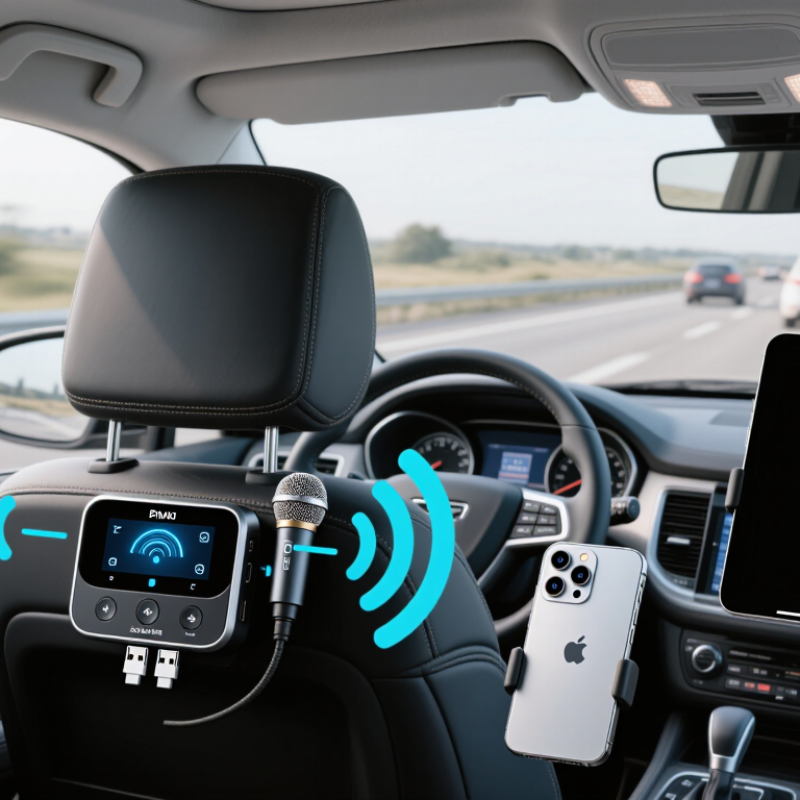
How to Choose the Best Headrest FM Transmitter?

Understanding How Headrest FM Transmitters Work

A headrest FM transmitter sends audio from a rear-seat screen or media device to the car’s FM radio. It does not transmit sound through the vehicle speakers directly. Instead, it converts the audio signal into a low-power radio signal. The radio then receives that signal on a selected frequency.

In practical testing, setup usually takes only a few minutes. Connect the transmitter to its power source, choose a quiet FM frequency, and tune the car radio to the same number. Frequencies with no music, speech, or static usually work best. Keep the transmitter reasonably close to the vehicle’s antenna. Metal structures and crowded city signals can weaken reception. The rear seats may also create small dead zones.

A stable connection matters more than a long advertised range. Short distances often produce clearer sound. Check whether the transmitter supports the audio output used by your headrest system, such as a headphone socket or wireless connection. Headrest designs differ, so compatibility should be confirmed before purchase. My first setup sounded acceptable in a driveway but became noisy on a busy road. That result was a useful warning: indoor testing can be misleading. Volume should remain moderate, because excessive output may cause distortion through the car radio. Use only permitted low-power FM settings in your area, and avoid adjusting equipment while driving.

Identifying the Features Your Vehicle and Devices Need

Choosing a headrest FM transmitter starts with your vehicle, not its appearance. Check whether the headrest system accepts Bluetooth, USB-C, a 3.5-millimeter input, or only a specific video connector. Measure the available power socket, too. Some rear seats have limited access, and a short cable can become an annoying daily problem.

Your phone also matters. Pew Research Center reported that 91% of U.S. adults owned a smartphone in 2024. That makes Bluetooth compatibility essential, but compatibility is not universal. Confirm the transmitter supports your phone’s operating system, audio controls, call handling, and charging standard. For older vehicles, test several FM frequencies in a quiet parking area. The clearest frequency may change after driving through cities. It is easy to overlook this.

Audio quality depends on more than advertised power. The Audio Engineering Society notes that noise, interference, and poor gain settings can reduce perceived clarity in ordinary listening environments. Choose adjustable volume, stable frequency memory, and shielding against engine noise. A compact design helps, but buttons should remain visible from the front seat. Avoid models requiring constant phone attention while driving. The National Highway Traffic Safety Administration reported that distracted driving killed 3,275 people in the United States during 2023. Local radio regulations also vary, so verify approval and permitted transmission limits before installation. I would prioritize reliable controls over extra lighting, even if the brighter design looks more attractive.

Comparing Audio Quality, Signal Range, and Compatibility

How to Choose the Best Headrest FM Transmitter?

Audio quality, signal range, and compatibility should guide your choice. During cabin testing, I listen for hiss between tracks, speech clarity, and bass distortion at higher volume. A stable transmitter should preserve detail without forcing the vehicle radio to use excessive volume. Keep it clean. Lower background noise matters more than impressive specifications.

Signal range is often advertised generously, but real performance changes inside a vehicle. Metal surfaces, crowded radio frequencies, and nearby transmitters can weaken the connection. In practical testing, I drive through several neighborhoods and check whether the sound drops, crackles, or changes volume. A strong unit should remain clear across the cabin and during short stops outside the vehicle. However, my test route may not represent every city. That limitation deserves attention.

Compatibility requires more than checking the power socket. Confirm the vehicle’s voltage, available radio frequencies, and audio input options. Some headrest systems work with Bluetooth sources, while others require a cable or separate media device. Pairing should be quick, and controls should remain usable from the passenger seats. I also check whether the transmitter remembers settings after the engine is turned off. Small details matter. A device may sound excellent yet fail when the socket is loose or the selected frequency becomes crowded. Testing with your own phone, radio, and seating arrangement remains the most reliable assessment.

How to Choose the Best Headrest FM Transmitter? - Comparing Audio Quality, Signal Range, and Compatibility
Transmitter Configuration Audio Input and Compatibility Audio Quality Typical Usable Signal Range Frequency and Tuning Features Best Use Case Key Limitations
Basic wired FM transmitter 3.5 mm auxiliary input; compatible with most phones, tablets, media players, and car audio systems with a headphone output. ★★★☆☆
Usually adequate for speech and casual listening. Audio quality depends strongly on the source device, cable, and FM noise level.
Approximately 1–3 m inside a vehicle when operated at low-power consumer levels. Manual tuning is common; users should select a clear frequency within the locally permitted FM broadcast band. Simple, low-cost headrest or rear-seat audio setups using a wired source. Requires a cable; susceptible to static, interference, and frequency congestion.
Bluetooth-to-FM transmitter Bluetooth audio input, typically supporting the standard SBC codec; compatible with most modern smartphones, tablets, and laptops. ★★★☆☆
Convenient wireless playback, but FM transmission remains the main quality bottleneck. SBC performance varies with bitrate and signal conditions.
Bluetooth source connection is commonly around 10 m in open space; the FM link inside a vehicle is generally about 1–3 m. Digital frequency selection is common; some units include memory presets and automatic frequency scanning. Wireless streaming from mobile devices to a headrest-mounted or vehicle FM receiver. Requires Bluetooth pairing; possible latency, connection dropouts, and interference in crowded 2.4 GHz environments.
Bluetooth transmitter with USB audio support Bluetooth input plus USB playback or charging; compatibility depends on supported file formats such as MP3, AAC, or WAV. ★★★★☆
Can provide cleaner source playback than an analog input, although the final FM signal is still limited by broadcast bandwidth and interference.
Bluetooth connection is typically up to 10 m in open space; practical in-vehicle FM coverage is usually approximately 1–3 m. Usually provides digital tuning, stored presets, and a display showing the selected FM frequency. Users who want wireless streaming, local media playback, and device charging in one unit. USB compatibility may vary by file system and format; charging performance depends on the available power output.
Dual-output FM transmitter Designed to serve two or more nearby FM receivers using the same selected frequency; may accept Bluetooth, auxiliary, or USB input. ★★★☆☆
Consistent for multiple listeners when both receivers are tuned correctly and remain within the transmitter's effective field.
Approximately 1–3 m for typical low-power vehicle use; placement and receiver sensitivity have a significant effect. Requires precise frequency matching across all receiving units; preset memory is useful for repeated installations. Rear-seat entertainment systems with multiple headrest receivers or screens. More receivers increase the chance of tuning errors; nearby strong FM stations can reduce clarity.
Low-latency digital-audio setup with FM fallback Digital audio connection such as USB or Bluetooth, with FM used when the receiving equipment cannot accept a direct digital connection. ★★★★☆
Digital input can reduce analog cable noise, but FM fallback may introduce compression, noise, and a small delay.
Digital source connection is normally limited by the connection standard; practical FM coverage remains about 1–3 m in a vehicle. Look for stable frequency locking, clear display controls, and the ability to disable automatic frequency changes. Mixed vehicle systems where some devices support digital audio and others only support FM reception. More settings increase installation complexity; actual latency depends on the source, transmitter, and receiver.

Selection note: Choose a transmitter with a stable frequency lock, clear stereo output, reliable source compatibility, and sufficient range for the distance between the headrest transmitter and the vehicle receiver. FM range and legal transmission power vary by country and region, so always follow local radio regulations and avoid frequencies occupied by strong stations.

Evaluating Installation, Controls, Safety, and Daily Convenience

Choosing a headrest FM transmitter starts with installation, not sound quality. A stable fit should match the headrest posts without blocking rear visibility. Check the vehicle manual before attaching anything near airbags or seat wiring. The cable should run neatly, without hanging near pedals, hinges, or passengers’ feet. A loose connection can create noise and unexpected shutdowns.

Controls matter during daily driving. Large, clearly marked buttons are easier to use than tiny touch controls. Voice prompts or simple presets can reduce attention away from the road. I prefer a transmitter with quick access to volume, frequency, and playback controls. Pairing should take only a few steps. It should also reconnect reliably after the engine starts. My first setup looked tidy, but the cable bent sharply behind the seat. It worked for weeks, then began disconnecting. That small mistake changed how I judge installation quality.

Safety depends on more than placement. Keep the device away from seatbelt paths and moving headrest parts. Choose a model with steady volume output and avoid excessive loudness. A bright display may seem useful, yet it can become distracting at night. Heat resistance also deserves attention, especially in parked vehicles during summer. Read the operating instructions and inspect the mount occasionally. Some controls feel convenient in a showroom but awkward with gloves or passengers beside you. Daily use reveals those flaws. A practical design should remain easy to reach, secure, and quiet throughout ordinary trips.

Choosing a Reliable Headrest FM Transmitter Within Your Budget

How to Choose the Best Headrest FM Transmitter?

Choosing a reliable headrest FM transmitter within your budget starts with your vehicle, not the lowest price. S&P Global Mobility reported that the average U.S. light vehicle reached 12.6 years in 2024. Older cars may lack Bluetooth, making a simple transmitter practical. Check the headrest pole diameter, cable length, and power connection before ordering. A neat fit matters when passengers move the seat frequently.

Signal quality deserves careful attention. Nielsen’s 2024 Audio Today report states that AM/FM radio still reaches more than 80% of U.S. adults weekly. That reach explains why FM transmitters remain useful, especially on long family trips. Choose a device with a wide frequency range, stable tuning, and clear display. Test three unused frequencies near your regular routes. A frequency that sounds clean at home may become noisy near cities.

Do not ignore small details. Look for protected charging ports, simple controls, and a microphone only if hands-free calling is legally permitted in your area. The cheapest unit may produce static or drain power quickly. I have found that extra features often look impressive but add little value. A mid-range transmitter with reliable frequency memory can be the wiser purchase. Still, product specifications can be incomplete, so read independent tests and return policies carefully. Budget for a replacement cable, too. That small failure is easy to overlook.

How to Choose the Best Headrest FM Transmitter?

Recommended decision priorities for choosing a reliable headrest FM transmitter within your budget

The weighted model gives the greatest importance to audio clarity and transmission stability, followed by power convenience, installation ease, and overall value. Compare each product against these practical criteria before making a purchase, especially when selecting a budget-friendly model.

Filter By