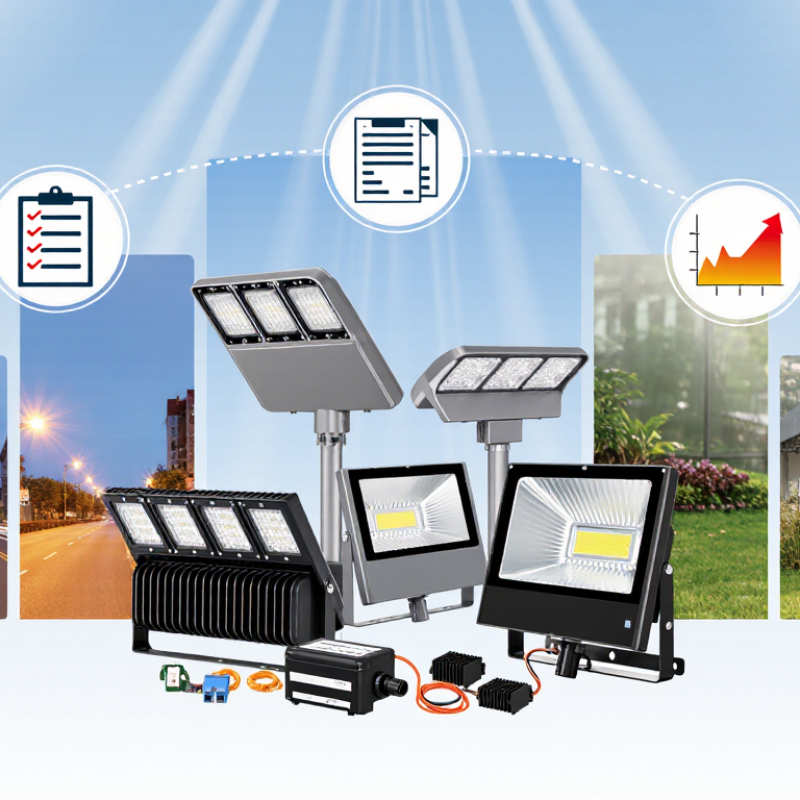
| Ingress Protection |
Protection against dust and water entry for the complete outdoor luminaire. |
IP65 as a common minimum for exposed outdoor luminaires; IP66 may be preferred for severe weather or high-pressure water exposure. |
IEC 60529 |
IP test report identifying the exact model, enclosure configuration, and test conditions. |
Insufficient sealing can cause corrosion, insulation failure, optical degradation, and premature LED driver failure. |
| Impact Resistance |
Mechanical resistance of the housing, lens, cover, and other accessible parts. |
IK08 or higher for many public-area applications; the required level depends on vandalism and installation risk. |
IEC 62262 |
IK classification report and product construction details showing which components were tested. |
Improves resistance to accidental impact, maintenance damage, and vandalism. |
| Electrical Safety |
Protection against electric shock, abnormal operation, overheating, and construction-related hazards. |
The luminaire should be tested for its intended voltage, frequency, insulation class, and installation environment. |
IEC 60598-1; relevant IEC 60598-2 product part |
Safety test report, wiring diagram, insulation class, grounding method, and rated input information. |
Helps reduce fire, shock, installation, and product-liability risks in different markets. |
| Road and Street Lighting Compliance |
Construction and safety requirements specific to road and street luminaires. |
Use the applicable national or regional adoption of the road-lighting luminaire requirements. |
IEC 60598-2-3 |
Compliance report for the exact street-light model, including mounting and operating conditions. |
Road authorities often require evidence beyond general outdoor-luminaire compliance. |
| Photometric Performance |
Measured luminous flux, luminous efficacy, beam distribution, intensity, and color characteristics. |
Compare delivered lumens and system efficacy at the complete-luminaire level, not LED-chip or module-only values. |
IES LM-79 or an equivalent recognized luminaire photometric test method |
Independent photometric report, IES/LDT file, test temperature, input power, and measurement uncertainty. |
Accurate photometric data supports lighting calculations and prevents exaggerated performance claims. |
| Color Rendering |
Color rendering quality for the intended application, including general color rendering and special color requirements where applicable. |
Ra 70 or higher is common for roadway lighting; Ra 80 or higher may be selected for pedestrian, retail, hospitality, or architectural areas. |
CIE 13.3 for traditional general color-rendering evaluation; project specifications may require newer color metrics. |
Color-rendering test data, nominal CCT, chromaticity coordinates, and product tolerance information. |
Consistent color quality improves visual recognition, safety, and project acceptance. |
| Correlated Color Temperature |
Stable color temperature suitable for the application and local regulations. |
Common outdoor options include approximately 2,700–3,000 K for warmer light and 4,000–5,000 K for neutral or cool white applications. |
CIE colorimetry principles; project requirements may specify ANSI or regional chromaticity tolerances. |
CCT tolerance, chromaticity coordinates, binning policy, and sample-to-production consistency data. |
Controls visual appearance, glare perception, ecological impact, and compatibility with existing lighting. |
| LED Lifetime and Lumen Maintenance |
Expected light-output maintenance over time under stated temperature and operating conditions. |
Request an L70 or L80 projection with the operating temperature, drive current, and maintenance assumptions clearly stated. |
IES LM-80 for LED package or module testing; IES TM-21 for lumen-maintenance projection. |
LM-80 data for the LED package or module, TM-21 calculation, thermal conditions, and stated projection limits. |
Prevents confusion between LED-component lifetime claims and complete-luminaire service life. |
| Thermal Management |
Effective heat dissipation from LED boards and driver components through the luminaire structure. |
Review rated ambient temperature, LED case temperature, driver temperature, thermal interface materials, and derating behavior. |
Thermal evaluation should support the applicable luminaire safety standard and manufacturer specifications. |
Thermal test report, maximum rated ambient temperature, temperature measurements, and installation clearance requirements. |
Excessive heat accelerates lumen depreciation, color shift, capacitor aging, and electronic failure. |
| Operating Temperature |
Reliable operation across the minimum and maximum ambient temperatures expected at the installation site. |
Select a product whose declared ambient range covers the project climate, with margin for solar heating and enclosed spaces. |
Declared according to product safety and performance test procedures. |
Operating temperature range, thermal derating curve, cold-start information, and high-temperature test results. |
Global projects may face desert heat, freezing temperatures, coastal humidity, or rapid temperature changes. |
| Surge Protection |
Resistance to transient overvoltage caused by switching events, utility disturbances, and lightning-related surges. |
A commonly specified outdoor arrangement is an external or integrated SPD rated around 10 kV, but the required rating must follow the site risk assessment and local specification. |
IEC 61000-4-5 for surge-immunity testing; installation requirements may also reference IEC 61643 series devices. |
Surge test level, test waveform, common-mode and differential-mode details, SPD status indication, and replacement procedure. |
Surge events are a frequent cause of outdoor driver failures and unplanned maintenance. |
| Electromagnetic Compatibility |
Controlled electromagnetic emissions and adequate immunity to disturbances from nearby equipment and power networks. |
The luminaire should meet the EMC requirements applicable in the destination market and installation type. |
CISPR 15 for emissions; IEC 61547 for immunity; other regional EMC requirements may apply. |
EMC test report, conducted and radiated emission results, immunity results, and exact driver model. |
Reduces interference with communication systems, sensors, controls, and other electrical equipment. |
| Power Factor and Harmonics |
Efficient use of electrical power with controlled reactive power and current distortion. |
For many commercial outdoor projects, buyers commonly specify power factor of at least 0.90 at rated load; confirm the project requirement. |
IEC 61000-3-2 for harmonic current emission requirements in applicable equipment categories. |
Power-factor data at different loads, total harmonic distortion, input-current waveform, and test conditions. |
Supports network compatibility, predictable energy consumption, and compliance with utility or tender requirements. |
| Flicker and Stroboscopic Effects |
Control of temporal light modulation caused by the LED driver and dimming system. |
Request measured flicker metrics at 100%, 50%, and minimum dimming levels; acceptance limits should follow the project specification. |
IEC TR 61547-1 and recognized temporal-light-modulation measurement practices. |
Flicker percentage, flicker index or Pst LM/SVM data where applicable, measurement frequency range, and dimming condition. |
Helps address visual comfort, camera compatibility, workplace concerns, and potential stroboscopic effects. |
| Photobiological Safety |
Assessment of optical radiation risks from the complete luminaire under intended use. |
Request the applicable risk-group classification and installation instructions, especially for high-output or narrow-beam products. |
IEC 62471 |
Photobiological safety report, risk group, measurement distance, and any viewing or mounting restrictions. |
Supports safe product selection for public spaces, workplaces, sports facilities, and architectural installations. |
| Dimming and Control Compatibility |
Reliable operation with the specified control protocol, sensors, photocells, or network-management system. |
Verify compatibility with 0–10 V, DALI, D4i, Zhaga, wireless controls, or other protocols required by the project. |
Protocol-specific requirements; DALI products may be evaluated against the applicable DALI specifications. |
Control interface specification, wiring diagram, dimming curve, minimum dimming level, and interoperability test results. |
Prevents commissioning delays, unstable dimming, control incompatibility, and unnecessary replacement of control equipment. |
| Materials and Corrosion Resistance |
Housing, fasteners, seals, coatings, and lenses suitable for moisture, salt spray, chemicals, and ultraviolet exposure. |
For coastal or industrial sites, specify corrosion-resistant materials and a coating system validated for the actual environment. |
Project-specific corrosion tests may reference ISO 9227 salt-spray testing; test results should not be treated as a direct service-life guarantee. |
Material declarations, coating system details, salt-spray report where relevant, fastener grade, and environmental limitations. |
Corrosion can compromise sealing, structural integrity, heat dissipation, and electrical safety. |
| Photometric Consistency |
Consistent color and light output between batches and replacement units. |
Specify acceptable chromaticity tolerance, lumen tolerance, and sampling procedure before mass production. |
Project specification and documented LED binning and production-quality procedures. |
LED binning policy, production inspection records, sample approval process, and batch traceability information. |
Maintains a uniform appearance across large installations and future replacement cycles. |
| Energy Performance |
Measured system wattage and delivered lumens at the actual operating point. |
Compare luminaire efficacy using identical test conditions, including driver losses, optics, temperature, and dimming level. |
IES LM-79 or equivalent recognized luminaire performance testing. |
Input power, delivered lumens, efficacy, power factor, test temperature, and dimming-state data. |
Accurate energy data is essential for lifecycle-cost calculations, carbon reporting, and utility planning. |
| Quality Management |
Controlled design, component purchasing, production, inspection, and corrective-action processes. |
Prefer a documented quality-management system such as ISO 9001, while verifying that the certificate scope covers the relevant products and facility. |
ISO 9001 quality-management-system requirements |
Valid certificate, certificate scope, production-site details, inspection plan, failure-analysis process, and corrective-action records. |
Reduces batch variation and improves accountability throughout the supply chain. |
| Warranty and Serviceability |
Clear coverage for the complete luminaire, driver, optical parts, corrosion, controls, and labor responsibilities. |
Require written warranty duration, exclusions, claim procedure, spare-part policy, and response times; avoid relying on verbal commitments. |
Contractual requirement; terms should comply with the governing law and project conditions. |
Signed warranty, replacement terms, spare-driver availability, repair process, serial-number traceability, and service contacts. |
Transparent after-sales terms reduce lifecycle risk when products are installed far from the manufacturing location. |
| Market Access Documentation |
Documentation required for import, installation, electrical approval, and project acceptance in the destination country. |
Confirm applicable regional requirements before purchase; conformity markings alone do not replace project-specific verification. |
Destination-market regulations and recognized conformity-assessment procedures. |
Declaration of conformity, safety and EMC reports, product datasheet, installation manual, label artwork, and customs documents. |
Complete documentation helps prevent customs delays, failed inspections, and non-compliant installations. |