What Are Waterproof LED Strip Lights and How Do They Work?
Waterproof LED strip lights are flexible lighting systems designed to resist moisture, dust, and occasional water exposure. They combine small light-emitting diodes, a circuit board, protective coatings, and a low-voltage power supply. The LEDs convert electrical energy into light with limited heat compared with traditional lamps. However, “waterproof” does not mean indestructible. That assumption can cause expensive mistakes.
The protection usually comes from silicone coating, silicone tubing, or a sealed extrusion. An IP65 strip can handle water jets, while IP67 and IP68 products offer stronger protection against temporary or continuous immersion. Always check the manufacturer’s rating. An outdoor patio, bathroom ceiling, and poolside wall create different risks. Water may enter through cut ends, connectors, or damaged seals. Small details matter.
Lighting engineer James R. Benya has said, “The quality of light is more important than the quantity of light.” His point applies directly here. A bright strip may still look harsh, uneven, or poorly matched to its space. Color temperature, LED density, diffuser quality, and voltage stability shape the final result. Longer runs can suffer from voltage drop, causing dimmer LEDs near the far end. Heat also remains relevant, even with waterproof protection. Aluminum channels can improve cooling and create cleaner lines.
This guide explains how waterproof LED strip lights work, how their protection ratings differ, and where installation problems often begin. The technology is practical. It is not foolproof. Careful selection and testing remain essential.
What Waterproof LED Strip Lights Are
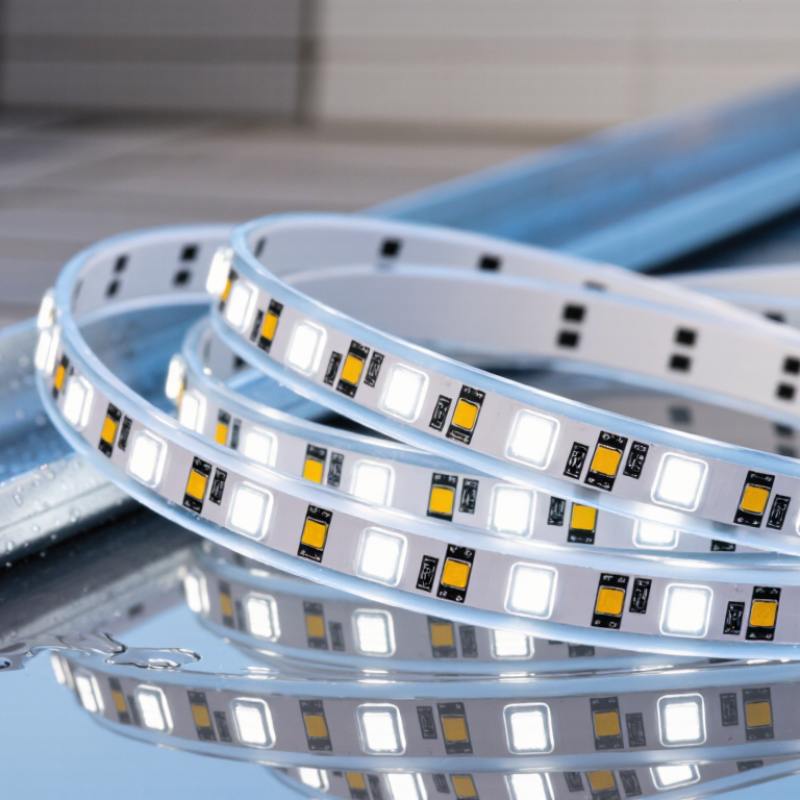
Waterproof LED strip lights are flexible circuit boards covered by a protective layer, usually silicone, PVC, or a sealed silicone tube. Small light-emitting diodes sit along the strip and produce steady, efficient illumination when electricity reaches them. The coating helps block moisture, dust, and accidental splashes. It does not automatically make every strip safe underwater.
The protection level is shown by an IP rating. For example, an IP65 strip can resist water jets, while an IP67 model can tolerate temporary immersion under specified conditions. Check the rating carefully. A strip may be waterproof, but its power supply, connectors, and cut ends may not be. I have seen installations fail because people protected the lighting but ignored the exposed connection.
These strips are useful under cabinets, around bathroom mirrors, on patios, and inside covered outdoor channels. Their adhesive backing makes installation simple, although it can weaken on dusty or damp surfaces. Clean and dry the mounting area first. A sealed aluminum channel can improve heat control and create a neater finish.
Waterproof does not mean maintenance-free. Sunlight, heat, standing water, and poor sealing can still shorten the strip’s life. Even a carefully designed installation may need inspection after heavy rain.
How Their Sealed Construction Protects Internal Components
What Are Waterproof LED Strip Lights and How Do They Work?
Waterproof LED strip lights use a sealed outer layer to shield LEDs, copper traces, and resistors. Common sealing materials include silicone, polyurethane, and flexible PVC. The cover blocks moisture, dust, and accidental splashes from reaching delicate electrical paths.
The protection level depends on the IP rating defined by IEC 60529. IP65 resists water jets. IP67 allows temporary immersion up to one metre, usually for 30 minutes under test conditions. IP68 requires manufacturer-specified immersion limits, so the label alone is not enough.
Sealed construction also affects heat removal. LEDs produce less heat than incandescent lamps, but trapped heat can still shorten component life. The U.S. Department of Energy reports that LEDs use at least 75% less energy and can last up to 25 times longer than incandescent bulbs. That advantage depends on proper thermal design.
Tips:
Inspect cut ends, connectors, and mounting gaps. A sealed strip can still fail through an exposed solder pad. Use compatible waterproof connectors. Do not assume every IP67 product suits permanent underwater use. Installation conditions matter more than marketing language. In practice, I have seen condensation form inside poorly sealed end caps, even when the strip itself looked flawless. That detail is easy to miss.
How LEDs, Circuits, and Power Supplies Produce Light
Waterproof LED strip lights place light-emitting diodes on a flexible circuit board. A silicone or plastic coating shields the board from splashes, dust, and moisture. The rating matters. Under IEC 60529, IP65 resists water jets, while IP67 supports temporary immersion. These ratings do not guarantee permanent underwater operation. The word waterproof is often too casual.
Inside the strip, LEDs connect in small series groups. Resistors or current-control components limit electrical flow. When voltage reaches each group, electrons release energy as visible light. A power supply converts household AC into low-voltage DC, commonly 12 or 24 volts. Higher-voltage strips usually reduce current and voltage drop over longer runs. Still, poor connections can create dark sections or uneven brightness. PWM dimming switches the circuit rapidly, making the light appear softer without changing its color directly.
The U.S. Department of Energy’s Energy Saver data reports that LEDs use at least 75% less energy than incandescent lighting. It also reports lifespans up to 25 times longer. The DOE’s Solid-State Lighting R&D report identifies 200-lumen-per-watt performance as an important white-light benchmark. These figures describe LED technology broadly, not every waterproof strip. Coatings add thermal resistance, and heat remains a practical weakness. A tightly sealed strip may run hotter than an exposed one. Installation mistakes matter more than many labels suggest. Power calculations should include length, wattage, cable resistance, and ventilation.
What Waterproof Ratings Mean for Different Environments
What Are Waterproof LED Strip Lights and How Do They Work?
Waterproof LED strip lights use sealed circuit boards, silicone coatings, or flexible outer sleeves. These barriers limit water, dust, and corrosion around the LEDs and electrical paths. Their real protection depends on the IP rating, defined by IEC 60529. The first digit measures solid-particle protection. The second measures water resistance. Higher numbers do not automatically mean better performance everywhere.
IP65
IP65 means dust-tight protection and resistance to water jets. It suits covered patios, kitchens, and sheltered signage.
IP67
IP67 adds temporary immersion protection, commonly tested at one metre for up to 30 minutes. This rating fits pool edges and damp outdoor features, but not permanent underwater lighting.
IP68
IP68 supports deeper or longer immersion under manufacturer-defined conditions. Those conditions matter. An IP68 product may not match another IP68 product.
Industry testing guidance also warns that connectors, cut ends, and power supplies can become weak points. A fully sealed strip can still fail after an exposed connection absorbs moisture. Thermal stress creates another risk. The U.S. Department of Energy’s solid-state lighting reports repeatedly identify heat management as a key factor in LED reliability, and waterproof coatings can reduce heat dissipation.
Check the installation surface, drainage, cable glands, and operating temperature. I once saw a “waterproof” installation fail beside a sprinkler because its connector was only splash-resistant. The label was not the whole system. Test results help, but installation quality still needs honest review.
How to Choose, Install, and Maintain Waterproof LED Strips
What Are Waterproof LED Strip Lights and How Do They Work?
Waterproof LED strip lights place light-emitting diodes on a flexible circuit board, then protect them with silicone coating, tubing, or full encapsulation. The seal limits damage from splashes, humidity, and dust. However, “waterproof” is not a universal promise. IEC 60529 classifies protection through IP ratings: IP65 resists water jets, IP67 allows temporary immersion, and IP68 depends on the manufacturer’s stated conditions. Check the rating before installing lights near a pool, shower, or outdoor step.
Choose the strip by location, brightness, color temperature, and voltage. A warm 2700–3000K strip suits bedrooms, while 4000K often works better under cabinets. Measure the run first. Long sections may lose brightness near the far end, so divide the circuit or use power injection. Select a driver with roughly 20% spare capacity, and keep all connectors inside matching waterproof enclosures. Energy STAR reports that LEDs use at least 75% less energy and can last up to 25 times longer than incandescent lighting, but poor installation can shorten that advantage.
Clean the silicone surface with a soft, damp cloth. Do not pierce the coating casually. Inspect end caps after severe weather, because tiny gaps can admit moisture. I have found that adhesive backing often fails on dusty concrete or rough wood; clips provide better support. Heat also matters. A strip trapped against insulation may dim sooner, despite its impressive rating. The installation plan should be questioned before the lights are switched on.
Waterproof LED Strip Lights: Understanding IP Water-Protection Ratings
The second digit in an IP rating describes water resistance under IEC 60529 testing. IP65 protects against water jets but is not designed for immersion. IP67 supports temporary immersion up to 1 meter for up to 30 minutes, while IP68 supports continuous or deeper immersion under conditions specified by the manufacturer. Seal connectors and cut ends carefully, because the strip rating alone does not guarantee a waterproof installation.