How to Choose the Best Outdoor LED Strip Lights in 2026?

Choosing the best outdoor led strip in 2026 requires more than comparing brightness and price. Outdoor conditions expose weak products quickly. Rain enters poorly sealed connectors, sunlight fades plastic jackets, and long runs lose brightness near the final metre.

Industry evidence supports careful selection. The International Energy Agency reports that LED technology now dominates new lighting installations because of its efficiency and long service life. The U.S. Department of Energy also identifies improved controls, thermal management, and product reliability as continuing priorities in solid-state lighting. These findings matter outdoors, where heat, moisture, and unstable voltage can reduce real-world performance.

Look beyond marketing claims.

Start with protection and electrical design. IEC 60529 ratings help explain enclosure resistance, but an IP rating does not guarantee connector quality or installation success. For exposed walls, balconies, and garden paths, IP65 may suit splash protection, while IP67 offers stronger resistance against temporary water exposure. Always verify the complete system, not only the flexible strip.

Brightness needs context. Lumens per metre, watts per metre, colour temperature, and CRI should be reviewed together. A warm 2700K strip can make timber appear richer, while 4000K may reveal pathway details more clearly. Long installations also need voltage-drop planning, suitable power supplies, and injection points.

There is no perfect checklist.

Reports from Grand View Research and MarketsandMarkets indicate continuing growth in LED and smart-lighting demand, but forecasts cannot replace physical testing. Inspect adhesive strength, cable flexibility, controller response, and visible heat after several hours. A small sample installed outdoors for one week may reveal more than a polished specification sheet. Reliable choices combine published standards, practical experience, and honest attention to installation limits.
How to Choose the Best Outdoor LED Strip Lights in 2026?

Understanding Outdoor LED Strip Light Types and Core Specifications

Outdoor LED strip lights are not one uniform product. They differ by voltage, sealing method, LED density, and installation purpose. The International Energy Agency reports that lighting uses about 15% of global electricity. Efficient outdoor selection therefore matters beyond appearance.

Flexible strips usually use 12V or 24V DC power. A 24V model reduces voltage drop across long runs, especially above five metres. Check lumens per metre, watts per metre, colour temperature, and CRI before choosing. Higher CRI produces more natural colours on patios and garden walls. For relaxed seating, 2700K to 3000K often looks warmer. Cooler light can reveal more detail, but may feel harsh.

Water protection needs careful reading. IP65 resists water jets, while IP67 tolerates temporary immersion under defined test conditions. Neither rating guarantees permanent underwater use. The U.S. Department of Energy’s Solid-State Lighting R&D Opportunities report highlights efficiency, thermal control, and reliability as continuing LED priorities. Heat still shortens service life. Use aluminium channels for exposed runs. They spread heat and create a cleaner line.

Look for UV-resistant silicone, sealed solder points, and a suitable outdoor power supply. An oversized strip on a small controller may flicker or fail early. I have seen adhesive loosen on dusty brick after one wet season. Mechanical clips would have been wiser. Specifications can look impressive, yet installation details often decide the result. Check the cut interval, connector seal, operating temperature, and maximum supported run before ordering.
Matching Brightness, Color, and Effects to Your Outdoor Space

Choosing outdoor LED strip lights starts with the space, not the product box.

I measure the patio edge, stair width, and viewing distance before comparing brightness. For seating areas, 300–600 lumens per meter often feels comfortable. Pathways may need more near dark steps. Too much light creates glare on wet stone.

That mistake is easy to make. I once chose a brighter strip for a narrow balcony, then lowered it with a dimmer.

The softer setting looked better and used less energy.

Color temperature changes the entire mood.

Warm white, around 2700–3000K, suits wooden decks, dining areas, and evening relaxation.

Neutral white, near 4000K, reveals steps and garden textures more clearly.

Cool white can look harsh beside brick or plants.

RGB lighting adds playful color, but I use it sparingly near seating areas. Constant color changes may feel exciting for ten minutes, then become tiring.

Effects should support the outdoor function.

Gentle fading works around a pool or pergola, while chasing patterns suit occasional gatherings.

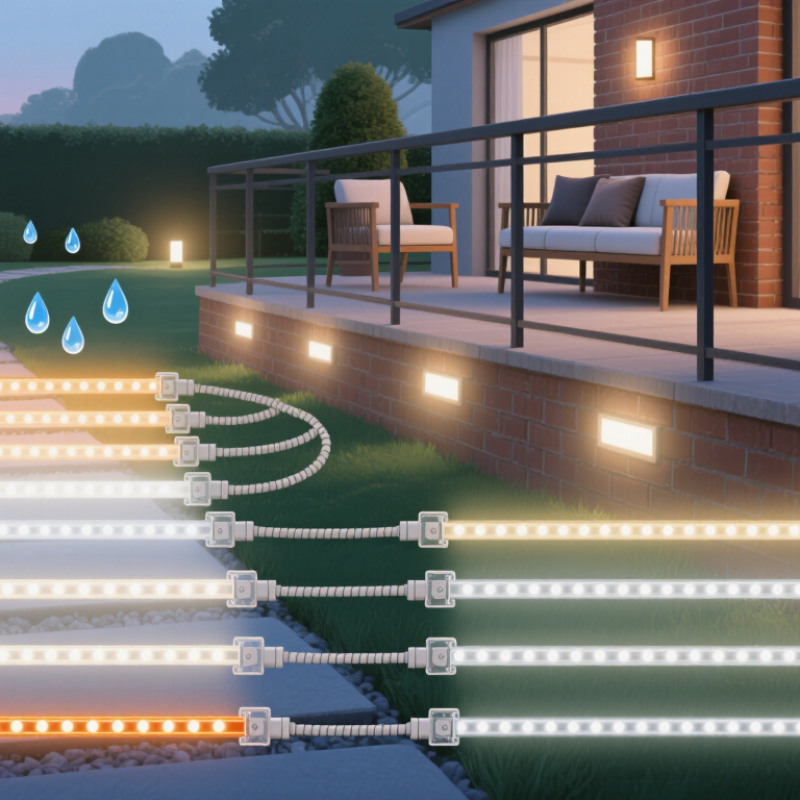
Check the IP rating, sealed connectors, UV resistance, and drainage around every connection. IP65 may handle rain, but exposed joints still need protection.

Test a short section at night before installing the full length. Voltage drop can make the far end visibly dimmer.

I have overlooked this before. A suitable power supply, aluminum channel, and professional electrical advice improve reliability, especially near mains wiring.

Checking Weather Resistance, Safety Ratings, and Build Quality

How to Choose the Best Outdoor LED Strip Lights in 2026?

Weather resistance should be your first inspection point. Look for a clearly stated IP rating, not vague words such as waterproof. IP65 protects against dust and water jets, while IP67 allows temporary immersion. Neither rating guarantees safe installation underwater. Check the entire system, including connectors, power supplies, and end caps. A sealed strip can still fail when water enters through a poorly fitted joint.

Safety ratings matter just as much. Choose a low-voltage system with a power supply tested by a recognized safety laboratory. The voltage must match the strip and controller. Installations near pools, paths, or damp walls may require additional ground-fault protection under local electrical rules. Ask for test documentation. A printed symbol alone is not enough evidence.

Build quality becomes obvious during handling. Flexible copper conductors, strong adhesive backing, UV-resistant silicone, and tight connectors usually indicate better construction. The strip should bend smoothly without exposing solder points. I once trusted adhesive alone on a hot exterior wall, and the lighting sagged after several weeks. Mechanical clips would have helped. Leave room for ventilation around the power supply, since enclosed heat can shorten its service life. Inspect cut marks carefully. Some strips tolerate cutting only at marked intervals.

Planning Power, Controls, Installation, and Long-Term Maintenance

How to Choose the Best Outdoor LED Strip Lights in 2026?

Planning begins with power, not appearance. Measure each run and record its wattage per metre. A five-metre strip rated at 14.4 watts per metre needs 72 watts. Add at least 25% capacity for the power supply. That means choosing approximately 90 watts. This margin supports cooler operation and future adjustments. The U.S. Department of Energy reports that LED lighting can use up to 75% less energy than incandescent lighting and last up to 25 times longer. Efficiency still depends on ventilation, wiring, and heat control.

Controls should match the installation, not just the mood. Confirm voltage, dimming method, load range, and outdoor enclosure ratings. A controller placed under an eave may face less rain, but condensation remains possible. Use components tested under IEC 60529 ingress-protection standards, especially near sprinklers or pools. Smart scheduling can reduce unnecessary runtime. The International Energy Agency identifies lighting as roughly 15% of global electricity consumption, so small control improvements can matter across large properties.

Installation details decide long-term reliability. Seal cable joints, create drip loops, and avoid tight bends around corners. Keep the strip away from standing water and dark, heat-trapping cavities. Inspect adhesive failure, cracked seals, and discolored lenses at least twice yearly. Clean gently; abrasive tools can damage coatings. I still allow extra cable length because neat plans sometimes fail onsite. That margin feels wasteful, but replacing a buried connection costs more. Load testing before final sealing is easy to skip. It should not be.

How to Choose the Best Outdoor LED Strip Lights in 2026

Electrical planning example for a 24 V outdoor LED strip rated at 10 W/m. The recommended power supply includes a 20% capacity reserve: power supply size = total LED load × 1.2. Actual consumption, maximum run length, voltage-drop limits, controls, waterproof connections, and maintenance requirements must be confirmed from the selected product’s technical data sheet.

Comparing Costs, Energy Efficiency, and Overall Outdoor Value

How to Choose the Best Outdoor LED Strip Lights in 2026?

Cost begins with wattage, not the purchase price. A 10-meter strip using 60 watts for five hours nightly consumes about 110 kilowatt-hours yearly. At $0.16 per kilowatt-hour, that equals roughly $17.60 in electricity. The U.S. Department of Energy reports that LED lighting uses at least 75% less energy than incandescent lighting and lasts up to 25 times longer. These figures are useful, but outdoor heat, moisture, and poor ventilation can reduce real-world performance.

Look for the total system cost. Include the strip, weatherproof driver, connectors, mounting channels, and possible replacement labor. An IP65 or higher rating helps protect against rain, but the rating does not guarantee safe connections. Seal every joint carefully. ENERGY STAR’s lighting guidance also emphasizes efficient power supplies and verified performance, not brightness claims alone. For long installations, choose a low-voltage system with a driver sized above the strip’s maximum load.

The best value is not always the brightest option. A warm-white strip around 2,700–3,000K often creates a calmer patio atmosphere while using less power than high-output color-changing models. I still measure the installation first; wasted strip length quietly raises costs. The math looks simple. Installation is not. Check warranty terms, replacement access, and seasonal temperature changes before buying. A cheaper kit may become expensive after one wet winter.

How to Choose the Best Outdoor LED Strip Lights in 2026? - Comparing Costs, Energy Efficiency, and Overall Outdoor Value

Comparison of common outdoor LED strip configurations for patios, decks, pathways, architectural accents, and landscape lighting.

Outdoor LED Strip Type Typical Input Power Consumption Typical Brightness Approx. Efficiency Weather Protection Recommended Maximum Continuous Run Typical Strip Cost
per Meter
Estimated Annual Energy Cost
per 10 m
Installation and Control Requirements Overall Outdoor Value
12 V single-color strip
Budget choice
12 V DC 4.8 W/m 300–450 lm/m Approximately 63–94 lm/W IP65 for covered locations; IP67 for exposed areas Approximately 5 m before voltage-drop compensation US$8–18/m Approximately US$15
(at 4 hours/day and US$0.22/kWh)
Requires a 12 V power supply. Shorter runs and additional power injection may be necessary. Low purchase price and low operating cost, but less suitable for long outdoor runs.
24 V high-output single-color strip 24 V DC 14.4 W/m 1,000–1,400 lm/m Approximately 69–97 lm/W IP65 or IP67, depending on the product construction Up to 10 m; power injection may be required US$14–30/m Approximately US$47
(at 4 hours/day and US$0.22/kWh)
Needs a larger 24 V power supply, suitable heat dissipation, and a stronger mounting surface. Best for task lighting and large outdoor spaces where high brightness is required.
24 V RGBW strip 24 V DC 14.4–19.2 W/m 600–1,000 lm/m in white mode Approximately 31–69 lm/W in white mode IP65 or IP67; connectors must also be weather protected Approximately 5–10 m, depending on channel loading US$18–38/m Approximately US$47–63
(at 4 hours/day and US$0.22/kWh)
Requires a multi-channel controller, compatible power supply, and sealed connectors or junction boxes. Strong decorative value and tunable white light, but higher equipment cost and energy use.
24 V addressable strip 24 V DC 14.4–20 W/m at full white 500–900 lm/m in white mode Approximately 25–63 lm/W in white mode IP65 or IP67; data connections need additional sealing Approximately 5 m per data segment; power injection may be needed US$20–45/m Approximately US$47–66
(at 4 hours/day and US$0.22/kWh)
Requires a compatible data controller, correct signal direction, power injection, and waterproof connections. Excellent for animated effects and signage, but unnecessary for simple illumination.
24 V silicone neon-flex strip 24 V DC 10–14 W/m 500–800 lm/m Approximately 36–80 lm/W Typically IP67; some constructions are suitable for temporary water exposure Approximately 5–10 m, depending on power and product design US$20–45/m Approximately US$33–47
(at 4 hours/day and US$0.22/kWh)
Requires purpose-made end caps, sealed connectors, appropriate clips, and a 24 V power supply. High visual quality, strong diffusion, and excellent protection, although material and installation costs are higher.

Calculation basis: Annual energy cost assumes 10 meters operated for 4 hours per day, 365 days per year, at US$0.22 per kWh. Actual electricity rates and operating schedules vary by location.

Cost scope: Strip prices are typical non-brand retail ranges and exclude the power supply, controller, mounting hardware, wiring, labor, and waterproof junction boxes.

Weatherproofing note: An IP rating applies only when the complete installation—including end caps, connectors, cable entries, and power connections—is sealed correctly. Power supplies should normally be installed in a dry, ventilated enclosure unless specifically rated for outdoor use.

Selection guidance: Choose 24 V single-color strips for most general outdoor lighting. Select high-output versions for task lighting, RGBW or addressable versions for color effects, and silicone neon-flex products when continuous diffused lines and stronger physical protection are priorities.

Filter By