Why Choose LED Lights for Your Business?
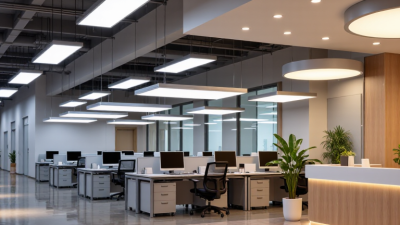
Why choose LED lights for your business? The answer often starts with daily details. A shop floor stays bright through closing. A stockroom’s labels are easier to read. A storefront sign remains visible after dusk. Lighting affects comfort, visibility, and operating costs, so the decision deserves more than a quick price comparison.
LED lights can use less electricity than many older lighting technologies and often last longer. Actual results depend on product quality, operating hours, and installation. Longer-lasting lamps may mean fewer replacements and less disruption in spaces with high ceilings or extended business hours. Still, “LED” alone does not guarantee good lighting. Color temperature, brightness, glare control, and dimming compatibility all matter. A cool, intense light may suit a workshop but feel harsh at a café table. Small choices add up.
A careful upgrade starts with reviewing existing fixtures, energy use, and the tasks performed in each space. Check product specifications, warranty terms, and independent performance information where available. For complex layouts, consult a qualified lighting professional. The payback may be slower than expected, especially when current lamps run for only a few hours each day. That is worth admitting. Good lighting is not just a utility-bill calculation. It should help employees work safely, let customers see products clearly, and suit the character of the business. When the balance is right, the benefits are practical—and visible every day.
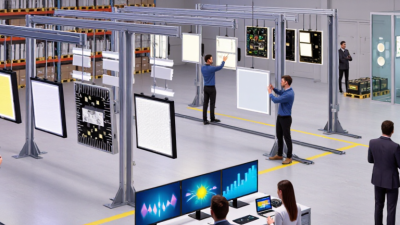
LED Lighting Basics: How Solid-State Diodes Produce Light
An LED produces light at a semiconductor junction, rather than by heating a wire until it glows. When electric current crosses the junction, electrons meet vacancies called holes. Their recombination releases energy as photons. The semiconductor’s bandgap influences photon energy, and therefore the light’s color. That is the key. Many white LEDs use a blue diode and a phosphor layer that converts some blue light into broader wavelengths. The mixture appears white, though its color quality can vary.
An LED needs a driver to regulate current from a building’s electrical supply. Without stable current, light output may fluctuate or components may wear prematurely. Heat still matters. Even though LEDs waste less energy as heat than many older light sources, heat builds up at the diode junction. A metal heat sink, clear airflow, and sensible fixture placement help manage it. In a real workspace, a dusty enclosed fixture may run hotter than its specifications suggest.
For a business, the diode is only part of the lighting system. Lens design, color temperature, glare control, and driver quality shape what employees actually see. Check measured light output and distribution for the room, not just the wattage on a product label. One detail is easy to overlook: a bright aisle can still leave a workbench poorly lit. I would not assume every LED installation saves the same amount; results depend on operating hours, controls, and the lighting being replaced.
Energy Savings: The U.S. DOE Says LEDs Use at Least 75% Less Energy
For a business, lighting runs through every shift, from the stockroom’s early deliveries to the last checkout. The U.S. Department of Energy says LEDs use at least 75% less energy than incandescent lighting. That comparison matters: it is not a guarantee that every business will cut its lighting bill by 75%. Actual savings depend on existing fixtures, operating hours, and controls. Still, replacing older incandescent lamps can make the meter spin more slowly. The difference is easiest to see in high-ceiling areas where lights stay on for long stretches.
The DOE’s 2020 U.S. Lighting Market Characterization estimated that LEDs accounted for about 48% of installed U.S. lighting. Adoption is growing, but many businesses still have room to upgrade. A practical check is to record fixture wattage and daily operating hours before choosing replacements. For example, a 100-watt incandescent lamp replaced by a 25-watt LED saves about 75 watts while it is on. Small numbers add up across a long hallway or a busy sales floor. Not instantly, though. Installation costs, color quality, and dimming compatibility deserve attention too; energy savings alone do not make every retrofit a good fit.
Service Life: The U.S. DOE Reports LEDs Can Last Up to 25 Times Longer
Why Choose LED Lights for Your Business?
A failed light above a checkout counter can disrupt work and require a ladder, staff time, and a replacement. Longer service life can reduce those interruptions. The U.S. Department of Energy says LED bulbs can last up to 25 times longer than incandescent bulbs. It also reports that LEDs use at least 75% less energy. The lifespan comparison is useful, but it is not a promise that every commercial LED fixture will last 25 times longer than every existing light.
Consider a fixture operating 10 hours each day. A 25,000-hour rated life works out to roughly 6.8 years of use. That is a planning estimate, not a guarantee. Heat, frequent switching, poor ventilation, and the quality of the driver can affect real-world performance.
DOE guidance also notes that LED life is often based on how long light output remains above a defined level, rather than the moment a lamp stops working. So a light may grow dim before it fails. Checking product lifetime ratings and the conditions behind them can help businesses compare options, though the fine print is easy to overlook.
Business Applications: Choosing LED Output, Color, and Controls for Each Space
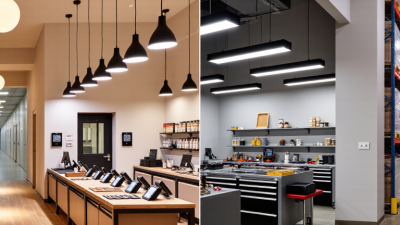
Choose LED output according to the work beneath each fixture, not square footage alone. A packing bench needs bright, even task lighting; a reception area may benefit from softer illumination. The U.S. Department of Energy reports that LEDs use at least 75% less energy and last up to 25 times longer than incandescent lighting. Actual savings vary with operating hours, fixture design, and existing equipment. Glare matters, too.
Color should suit the space. Neutral white light can help staff inspect labels and surfaces, while warmer tones may make a lounge feel more inviting. Check color rendering when accurate product colors matter, such as in retail displays or quality checks. Pair dimming with occupancy sensors in meeting rooms and daylight controls near windows. Controls work best when they match daily routines. A sensor that switches off during desk work will frustrate people; that human detail is easy to overlook.
Tips: Test a sample fixture at its actual mounting height. Check brightness, glare, and dimming, then ask staff for feedback after a week. A small trial can reveal problems on paper plans.
Purchase Decisions: Compare Installed Cost, ENERGY STAR Ratings, and Rebates
Why Choose LED Lights for Your Business?
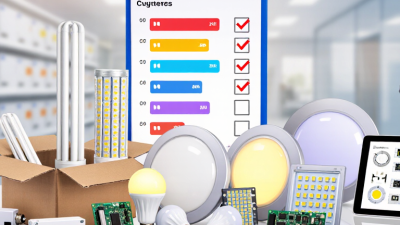
An LED quote is not just a fixture price. Compare the installed cost: luminaires, labor, controls, lift rental, and disposal. Then estimate annual energy use from wattage, operating hours, and your electricity rate. ENERGY STAR reports that LED lighting uses at least 75% less energy than incandescent lighting and can last up to 25 times longer. That is a useful benchmark, not a promise for every commercial retrofit; existing fluorescent systems may show different savings.
Check ENERGY STAR certification and the product’s rated output, color quality, and expected life. A low-cost fixture can be expensive if it creates glare or needs early replacement. The U.S. Department of Energy recommends evaluating efficiency investments over their service life, not by purchase price alone. Ask your utility about rebates before signing: eligibility may depend on fixture type, controls, project size, or pre-approval. Rules vary by location. A rebate can improve payback, but do not count it until approval is confirmed.
Tips
Request two itemized bids. Compare total installed cost, estimated annual kWh, maintenance assumptions, and rebate status side by side. Keep the utility bill nearby. One weakness in many comparisons: estimated operating hours are often optimistic. Check actual schedules in each space before trusting the payback figure.