Who Are the Top LED Ribbon Lights Suppliers in China?

LED ribbon lights appear in retail displays, cabinet edges, event spaces, and architectural details. Their slim profile can fit where rigid fixtures may not, but product quality varies. China has many manufacturers and trading companies serving overseas buyers. Telling them apart takes more than comparing catalog photos or unit prices. A polished website proves little. Details matter.

This guide explains how to assess leading Chinese suppliers through practical, verifiable factors: product range, customization options, production capabilities, quality-control procedures, and communication. It also considers whether suppliers can provide clear specifications for voltage, color temperature, brightness, cutting points, and compatible controllers. These details affect installation and the finished appearance. No supplier is perfect.

Before placing a large order, request samples and review the relevant technical documents. Ask how the supplier checks color consistency, adhesive performance, and operation over time. Confirm lead times, packaging details, warranty terms, and what support is available if a batch does not match the approved sample. Compare answers in writing, not just during a sales call. Supplier rankings can offer a useful starting point, but they cannot replace direct checks. Even careful research leaves some uncertainty; production quality may change between batches. The aim is to identify suppliers worth evaluating, then verify that their products fit your project, budget, and installation needs.
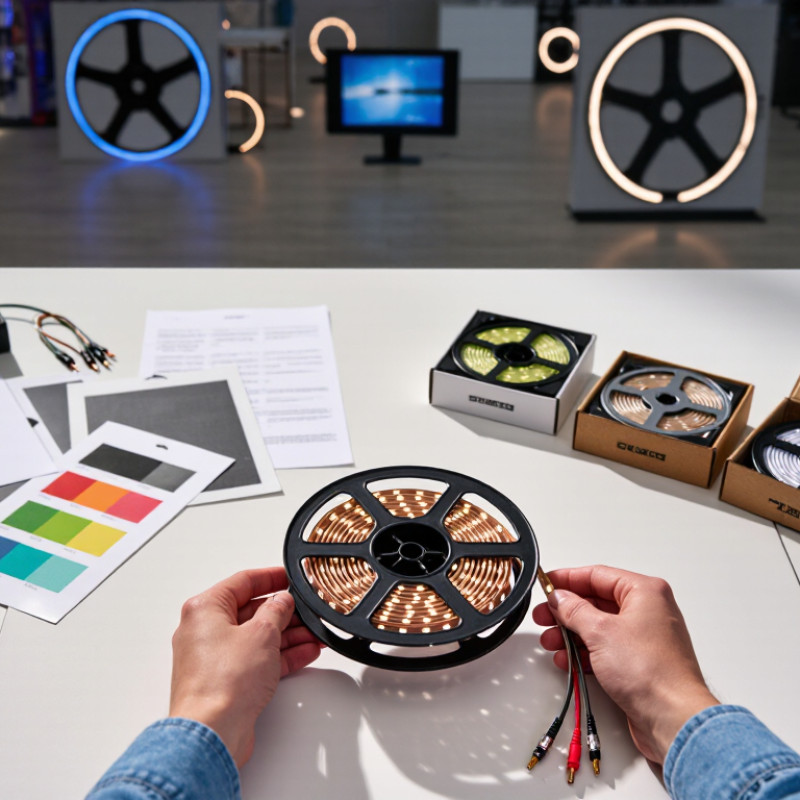
Who Are the Top LED Ribbon Lights Suppliers in China?

What Are LED Ribbon Lights and How Are They Used?

LED ribbon lights are flexible printed circuit boards fitted with closely spaced light-emitting diodes. They are often sold in reels and cut at marked points, then mounted under cabinets, along shelves, or inside display cases. A narrow strip can wash a backsplash with light, while a higher-density version creates a more continuous line. The result depends on spacing, diffuser, and installation quality. Small details matter.

Most ribbons run on low-voltage direct current and need a compatible power supply. Buyers should check voltage, watts per meter, color temperature, color-rendering information, and whether the strip is rated for damp locations. The U.S. Department of Energy’s Energy Saver guidance says LED bulbs use at least 75% less energy and can last up to 25 times longer than incandescent bulbs. That comparison is for LED bulbs generally, not a guarantee for every ribbon installation; heat, drivers, and operating conditions affect real-world life.

A cool aluminum channel can help manage heat, but it cannot fix an undersized power supply.

For projects sourced from China, suppliers should provide clear product specifications, photometric data, and sample reels for testing. Test the strip at its intended length: brightness can fall toward the far end if the wiring is poorly planned. Color may also look different beside warm wood than it does in a catalog. That part is easy to overlook.
How Is China’s LED Ribbon Light Supply Industry Structured?

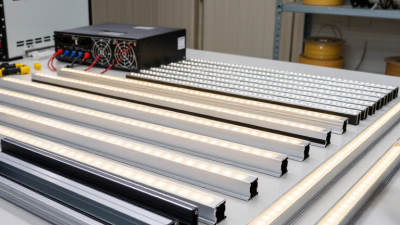
China’s LED ribbon-light supply industry is a layered manufacturing network, not a single factory category. Upstream suppliers provide LED chips, flexible circuit boards, resistors, and copper foil. Midstream firms mount components, apply protective coatings, and assemble reels. Some specialize in custom lengths, colors, or waterproofing; others focus on testing, packaging, and export coordination.

The China Semiconductor Lighting Alliance’s 2023 industry report put China’s broader semiconductor-lighting output value at about RMB 1.1 trillion. That figure covers much more than ribbon lights, so it should not be read as this product segment’s market size. Public data rarely separates ribbon-light makers from wider LED businesses. In practice, the chain often includes component makers, contract assemblers, and trading or export-service companies. Quality can vary. A bright sample does not guarantee consistent color across a full production run.

Tips: Ask for reel-level test records, not only a sample. Check voltage drop, color consistency, adhesive performance, and heat dissipation at the intended installation length. A small detail matters: verify whether the supplier makes the lights or coordinates production through partner factories.

What Criteria Distinguish Leading LED Ribbon Light Suppliers?

Leading LED ribbon light suppliers prove performance with test data, not polished product photos. The IEA’s 2023 Energy Efficiency report estimates lighting accounts for about 15% of global electricity use. The U.S. Department of Energy says LEDs use at least 75% less energy than incandescent lighting and can last up to 25 times longer. These figures are broad benchmarks, not guarantees for flexible strips. Ask suppliers for measured lumens per metre, watts per metre, and operating temperature. Then compare samples at the same length and voltage. Small details matter.

Check color consistency, too. Request CRI results, color-bin information, and LM-80 data for the LED package; ask how the supplier manages heat on long runs. A strip that looks even on a one-metre sample may show voltage drop near the far end. Test a full reel, including connectors, dimming, and the stated cut points. Strong suppliers provide dated test records and traceable production-lot checks. They explain tolerances plainly. If a datasheet omits copper thickness or ambient temperature, pause and ask for clarification. I would not treat a single sample as proof; production variation is easy to overlook.

Who Are the Top LED Ribbon Lights Suppliers in China? - What Criteria Distinguish Leading LED Ribbon Light Suppliers?
Evaluation Criterion What a Strong Supplier Should Offer Useful Specification or Evidence How Buyers Can Verify It
Product Range Options for indoor and outdoor use, with different widths, LED densities, color temperatures, and control methods. Catalog entries covering single-color, tunable-white, RGB, or RGBW products; reel lengths and cut intervals stated clearly. Request current datasheets and confirm that the offered configuration matches the installation design.
Electrical and Light Output Data Complete, consistent technical data for each specific product configuration. Rated voltage, watts per meter, LEDs per meter, luminous flux where applicable, and recommended power supply capacity. Compare datasheets with sample measurements and check that power and light-output figures identify the same model and operating conditions.
Color Quality Clearly specified color temperature and color-rendering performance, with suitable options for the application. Common white-light offerings include 2700 K, 3000 K, 4000 K, and 6500 K; CRI values of 80 or higher are common, with higher-CRI options available from some suppliers. Ask for test reports or sample measurements. For color-critical projects, specify the required CRI, color consistency, and color temperature tolerance in writing.
LED Binning and Consistency Documented controls to reduce visible color variation between production batches. Stated color-bin or chromaticity tolerance and a process for maintaining consistency across repeat orders. Compare samples from separate production batches and request the supplier’s written color-consistency specification.
Reliability and Thermal Design Product recommendations that account for ambient temperature, operating hours, installation surface, and heat dissipation. Defined operating-temperature limits, installation guidance, and documented reliability or lifetime assumptions. Review test conditions and warranty terms; confirm whether the strip requires an aluminum mounting profile for the intended installation.
Ingress Protection Appropriate protection choices for dry, damp, or exposed locations, without treating a rating as a substitute for correct installation. IP20 is commonly used for dry indoor settings; higher ratings such as IP65 or IP67 may be offered for applications needing additional protection. Check the exact product construction and test documentation. Verify connectors, cut ends, and installation methods, which can affect the completed system’s protection.
Compliance Documentation Documents that match the exact model, market, and product configuration being purchased. Applicable declarations, test reports, and safety or electromagnetic-compatibility documentation for the destination market. Check model numbers, issuing laboratory, document scope, and validity. Verify documents with the issuer when required.
Customization and Engineering Support Practical support for custom lengths, connectors, wire leads, packaging, and control-system compatibility. Written confirmation of design limits, sample lead time, production lead time, and any tooling or minimum-order requirements. Provide a project specification and assess the completeness and accuracy of the supplier’s technical response and sample.
Quality Control Traceable inspection procedures for incoming components, production, and finished goods. Documented inspection criteria, batch identification, and records for checks such as electrical operation and visual defects. Request a quality-control plan and sample inspection records; agree on acceptance criteria before placing an order.
Order and After-Sales Terms Clear, written commercial terms and a defined process for handling defects or technical issues. Quotation validity, minimum order quantity, payment terms, shipping terms, warranty conditions, and claim procedures. Review the contract and warranty wording, including exclusions, evidence requirements, and remedy options.

Which Chinese Suppliers Are Prominent in the LED Ribbon Light Market?

Prominent suppliers in China’s LED ribbon light market are often found in Guangdong’s lighting and electronics clusters, including Shenzhen, Zhongshan, and Foshan. These companies range from component-focused factories to exporters coordinating production across several workshops. Their strengths vary. Some offer flexible custom lengths and color temperatures, while others focus on stable output for larger orders.

Look beyond product photos. A capable supplier should explain LED density, voltage options, copper-board thickness, cutting intervals, and adhesive performance in practical terms. Ask for a sample reel and inspect its solder joints, printed polarity marks, and brightness consistency. Test it on the intended surface; adhesive that holds on clean aluminum may fail on dusty wood. Small details matter.

Quality records can help, but they need context. Request test information for heat, color consistency, and operating life, then confirm which production batch it covers. A polished catalogue proves little by itself. That is easy to overlook. Compare response times, packaging, and how clearly the supplier handles specification changes. I would not treat any supplier list as a ranking: capacity and service can change, and the best fit depends on the project’s installation conditions.

How Do China’s LED Ribbon Light Suppliers Compare?

China’s LED ribbon light suppliers differ less by location than by engineering discipline. Compare measured lumen output per meter, color consistency, copper trace thickness, and voltage drop over a full reel. A bright sample can still disappoint after installation. Ask for test results at the intended input voltage, plus photographs of solder joints and reel labels. Small details matter.

The U.S. Department of Energy’s 2022 Energy Savings Forecast reported that LED lighting saved about 1.6 quadrillion Btu in the United States in 2020. That figure is not a supplier ranking, but it shows why efficacy claims deserve scrutiny. Compare measured lumens per watt, not marketing language alone. For long runs, check voltage-drop data and whether the supplier recommends power injection. For damp locations, inspect the stated IP rating and how connectors are sealed. Request LM-80 data for the LED package and clarify whether lifetime projections use TM-21 calculations. Ask for a production sample. Then test it warm, dimmed, and at the reel’s far end. I would not treat one successful sample as proof of consistent mass production; that assumption is easy to make, and hard to verify.

Who Are the Top LED Ribbon Lights Suppliers in China?

How Do China’s LED Ribbon Light Suppliers Compare?

These are common nominal correlated color temperature (CCT) options, not supplier-specific sales figures or rankings. When comparing suppliers, confirm which CCTs they offer and request product datasheets to verify the actual specifications.

Filter By